Monday, August 1, 2011

Comic Book References in the movies Part I: 'Batman'

Every writer of the Batman movies had either an extensive prior knowledge of the Batman comic books or did an extensive research before writing the script. Each and every one of the theatrical Batman movies has numerous subtle and not so subtle nods and references to the comic books and reveals an impressive knowledge of the comic book back catalog. 
One of the last posts focused on differences and deviations from the comic books from each movie, listing the number of things which were changed to fit the story more and serve it better (http://gothamalleys.blogspot.com/2011/03/list-of-changes-in-movies.html). This time we'll focus on all the references and similarities to showcase the writers' knowledge of the Batman stories and to point out what was taken from the comics

BATMAN

Tim Burton's version of the mythology, by all accounts, was heavily based on the original Batman years and decade. Batman character specifically was very heavily based on Bob Kane's original version from the pre-Robin issues (more on Burton/Kane Batman here - http://gothamalleys.blogspot.com/2011/01/batman-in-movies.html), and many elements and villains were based on the first decade of Batman, called the Golden Age era. There's also a pinch of the 1980's thrown in as well, as well as the 1970's in Joker's character (more on the subject - http://gothamalleys.blogspot.com/2010/09/complete-history-of-joker.html)

Mark Canton (producer): "We did a lot of homework with Jeanette Kahn who was running DC in those days (Shadow of the Bat) 

1. The movie's logo was the same as the one from the comic books of the 80's


2. In "Greatest Batman Stories Ever Told", the producer Michael Uslan states that he showed 1974 story "Night of the Stalker" (Detective Comics #439) to Tim Burton. Both the story and the movie start out with an innocent family, which is suppose to mirror the Wayne family, encountering criminals and Batman being alarmed by the screams. In the comic book story, the criminals fire at Batman during their encounter with him and Batman also pretends to be dead.


3. Batman's first appearance in Detective Comics #27 had him appear on the rooftop to apprehend two criminals. Detective Comics # 27 begins several weeks after Batman has begun fighting crime, similar to how Batman begins with muggers already talking about Batman.


4. The particular use of the Batarang debuted in Detective Comics #214


5. Also worth noting is that the early Batman issues always had a spooky full moon over Gotham, just like in the movie


6. Gotham has its fair share of Gothic architecture and sculptures


7. Also, the cowl and the cape is seemingly one piece, yet the mask or the cape can be taken off separately. The cape is overlapping the shoulders and covering the entire body when in still position


Batman's emblem has extra points on the bottom of the wings which form the bat's legs. There were numerous instances in the 80's where Batman was depicted with extra points at the bottom of the bat in the emblem, and two of the comics that did so were cited as influence for the movie, notable The Dark Knight Returns and The Killing Joke


The definite inspiration here however is definitely The Killing Joke (panel below from last page)

 
The exact symbol ALSO appeared in 1986's Batman #400

As in some comics, the yellow emblem was meant to draw gunfire


Batman's voice in the movie is just as it was described as in the 70s and 80s, a cold whisper


8. Bruce Wayne occasionally sporting glasses

9. The second time Batman is in action in Detective Comics #27 is in the chemical factory


10. While in the comic books Joker, as in the movie, ends up in the vat of chemicals that bleach his skin, his origins in the movie is more based on the scene from the DC #27. In the comic books, Joker is a villain called Red Hood who jumps into a tank with chemicals to get away from Batman. In DC#27 and the movie, the villain falls into the tank during his encounter with Batman


11. Batman uses smoke pellets for escapes


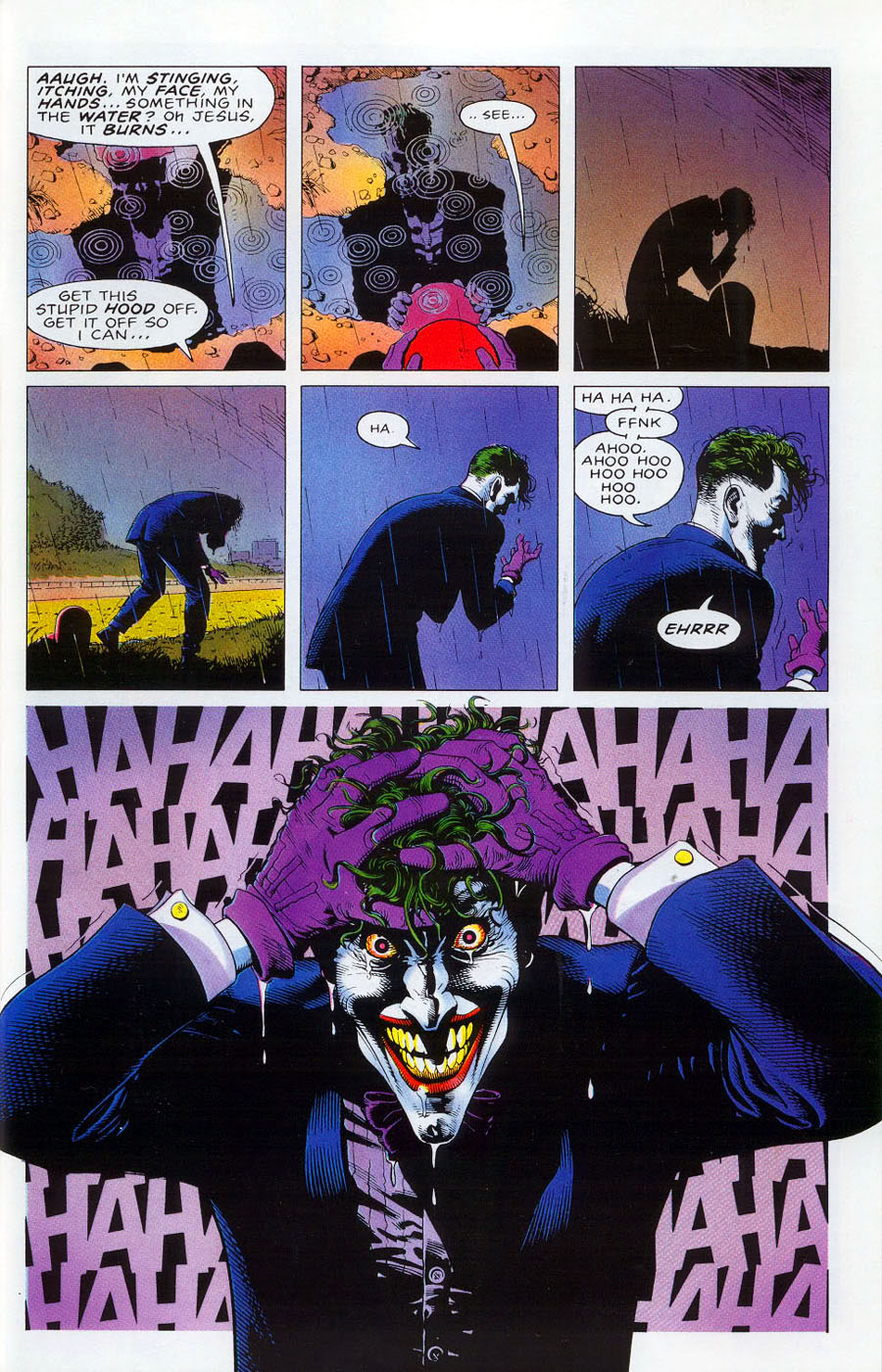
12. Joker goes crazy after first seeing his appearance (panels from 1951's Detective Comics # and 1988's The Killing Joke)

  

13. Joker is planning his next move out loud (panel from Batman #1)


It's important to note that Joker's appearance is also a mirror image of the Golden and Silver age Joker. The hair line, pointy eyebrows, purple eyeshadow, same laugh lines and the frozen grin are there (more in The Complete Joker History article). And even since Joker always had a long chin in the comic books, Nicholson wore a prosthetic chin which elongated his.


He was also shown to be very knowledgeable in chemistry 


14. Joker uses flesh color makeup to conceal his white skin, but his inhumane, frozen grin is still clearly dominating his appearance (panels from 1940's Batman #45 , two 1970's Joker comic books and 1988's Batman #427)


15. Joker killing his victim with seemingly fun prank gadget 


16. Talking to corpses 

17. Joker using different outfits and outlandish costumes for different occasions. In this instance, a funeral tuxedo


18. Joker being angered over the fact that someone steals his thunder in mass media (panels from Joker comic books)


19. The laugh gas originated in Joker's first appearance but disappeared during the Silver Age. It made its comeback in the 1970's. The structure of the poison is the same as well. It must be mixed with different compounds to become deadly, according to "The Laughing Fish"


20. The idea of Bruce visiting the alley where his parents died every year comes from 1976's Detective Comics #457


21. Joker , with his big ego, cannot help himself but to leave a sign of his presence in the art gallery/museum


22. Joker considers himself an artist of crime/homicidal artist. He is also in some ways into art. In Batman's earliest issues, Joker was an avid art collector


23. Joker dancing to the mainstream music when doing his deeds, desecrating art pieces (panels below from The Killing Joke and two Joker comic books)


Such deed also took place in the TV show in an episode called  "Pop Goes The joker" , in which Joker and his goons raid an art gallery and use paint to deface the art pieces.


Also, in the episode called "Zodiac Crimes", Joker makes his escape on a ladder hanging from a helicopter


24. Batman often opts to make an entrance through the glass rooftop


25. Joker tries to burn Vicky's face with his acid flower asking her to smell it. He did the same to Robin in 1987's Detective Comics #570


26. In Batman #1 Batman gets knocked out and there's an attempt to take off his mask. He quickly snaps out of it and fights off the opponents


27. Batman is mostly a silent figure. After saving Julie/Vicky, he doesn't utter a word


28.  The idea of a hologram entrance to the batcave is taken from The Dark Knight Returns


29. While the scene is more inspired by the scene from the Phantom of the Opera, Vicky was taken to the cave in 1948's Batman #49


30. Joker chasing skirt. The idea of him stubbornly wanting one specific woman is taken from Joker #4


31. Joker announces his next move and the time he will commit it in mass media.Also, in both cases he picks midnight as the time


32. Though the character is introduced in Detective Comics #27, we don't Batman's origin until Detective Comics # 33, similar to how the audience doesn't see Batman's origin until shortly before the climax. Bruce Wayne is often contemplating alone, deeply immersed in his thoughts


33. 'Monarch" was a name of the factory which contributed to Joker's birth in 1951. The name is reused in the movie and instead given to the place which contributed to the birth of Batman


34. Joker is a showman, doing everything in a big, parade or circus style way. The use of Joker's Birthday cake float is taken from 1980's Batman #321


35. Batwing/Batplane maneuvers and search is present, as well as the imagery of the moon backdrop


36. Batman guns down the thugs with machine gun from his Batplane/Batwing


37. Batman takes down his opponent with a leg lock, a move very often used in the earliest stories (panels below from Detective Comics #474 and Batman #4)


38. Joker making a use of his fake hand (panel from 1980's Batman #321)


39. Batman hangs from the high tower but manages to pull in when Joker falls down


40. When Joker falls he is described as frantic (panel from Batman #1)


41. Joker's changeless face still grinning even after his death


Special acknowledgement for fellow Batman historians BatmAngelus, thecolorsblend, Evil Twin 120 and BatmanMovieOnline


Friday, July 22, 2011

Rachel Dawes

Rachel Dawes was an original character created by David Goyer and Christopher Nolan specifically for this new incarnation of Batman mythology. The character appeared in both Batman Begins and The Dark Knight and was one of handful original characters created for Batman movies, however it's the only original character that experienced a casting change resulting in slight change of its portrayal. Whenever an actor is changed, there will always be a difference in the character, sometimes more sometimes less evident, but two different actors will never portray the same character exactly the same. An actor, or in this case an actress, will always influence her character in some degree. Let's take a look at Rachel's personality as portrayed by Katie Holmes and Maggie Gyllenhaal.

David Goyer: She's an amalgam of some characters but she didn't exist in the comic books (ropeofsilicon.com)

BATMAN BEGINS

Batman Begins first introduces us to the character, which is someone who knew Bruce since his childhood and who already had a strong bond with him. She is shown to actually witness Bruce's fall into the cave, something that Bruce had done without any companion in the comic book continuity.


Katie Holmes: It was fun to portray that relationship. That close-knit friendship. Where you have this understanding of each other based on the fact that you know each others’ pasts. And you’re just able to communicate about anything because you know each other so well. I thought it was a really beautiful relationship [with Batman] to explore.(Cinecon.com)

Partially because of her longtime bond with the young Wayne, she is also able to penetrate through his wall and guide him in the right direction when he looses his path. She, just like Alfred, is a guidance and moral consciousness for Bruce, and if not her, he would have followed a very different path clouded by his rage and pain. If not her, he would still be the lost spoiled prince (as Bale described Bruce in this stage) that wanted to kill Chill. Instead he rethought his life after her speech and ran off to change his life.


Christopher Nolan: I think she's got a wonderfully, warm and generous presence that's very glamorous. Very girl next door at the same time. Katie also has a maturity beyond her years that comes across in the film and is essential to the idea that Rachel is something of a moral conscience for Bruce. (indielondon.co.uk 2005) 

Jonah Nolan:  I think Rachel's character gives him a moral compass in the first film (ropeofsilicon.com 2008)

Katie Holmes: She was such as strong female character. And she’s tough. And she’s able to be honest with Bruce. And she tells him how she really feels and doesn’t apologize for it. And she wants to make a difference.(Cinecon.com)

While usually seen as tough and focused, she also gives Bruce warmth and moral support when he needs it. She did accept his choice of going to see Joe Chill's hearing and gave him her support and understanding when he needed and asked for it. She gives Bruce both the tough love and the delicate love. She supported him when he needed it (she understood and accepted his will to attend the trial), she was very sweet and open to him (ending scene) and also when he deserved it she was harsh on him and gave him tough love and criticized him when needed. The wise words of "its not who you are underneath" came from her, the whole "Bruce is your mask" statement did as well. She was sometimes sweet, sometimes arrogant, sometime tough, sometime supportive, sometime criticizing. She was a trusted, childhood friend, love interest and parent at the same time


It is also worth noting that Holmes is in family of attorneys so she definitely had role models to base her performance on 

Q. Your character helps Bruce Wayne find his social conscience/moral conscience. Were there any aspects of your upbringing or childhood that you found helpful to draw on to give conviction to this role?

Katie Holmes: Well, it was really exciting and fun to play an Assistant DA. I’m the daughter of an attorney and the sister of one. So that aspect was just kind of fun and I guess whenever you’re creating a character there subconsciously are things that you grew up with or parts of your personality that you put into it. So yes, a little bit. (Indielondon.co.uk 2005)

Rachel in Batman Begins is certainly no damsel in distress. She never really needs saving, and everytime when Batman intervenes she's handling or is just about to handle things herself. She was about to tase the two thugs that were trying to mug her and didn't show a bit of fear, only strength. She also picked up a gun during the chaos in the Narrows and was just about to start shooting the oppressors, taking up to help a young boy. The only time she really did need help was when she was gased by Scarecrow, but even Batman himself was helpless in the same situation and needed Alfred's help.


Katie portrayed a little girl who seemingly wouldn't be dangerous at all and who physically can be laughable for others as a threat, yet her personality greatly outgrows her physicality and surprises whoever meets her - and thats in part thanks to Katie's portrayal and in part thanks to her looks and what Nolan seemed to aim for ("Katie also has a maturity beyond her years that comes across in the film"). The young and fragile looks in this case added more dimension because it added that surprising and unusual "small puppy barking the loudest" element. They add an additional layer/color to the character, scripted or not.


.............................................................................................................. 

 THE DARK KNIGHT
  
The reason why Katie Holmes did not return to play Rachel is because of the scheduling conflicts with another movie, "Mad Money"

Earlier this month, Ms. Holmes rebuffed the "Dark Knight" offer, say people involved with the project. The studio is searching for a new actress who can replace Ms. Holmes in the big-budget picture, for which the salary range likely would have been $1 million to $2 million, say these people, compared to the roughly $1 million she earned for "Batman Begins."

"We never got to the negotiating stage" for "Dark Knight," says Julie Polkes, a spokeswoman for Ms. Holmes. "Katie was offered ["Dark Knight"] but was unable to accept the role because of scheduling conflicts. She was in the process of negotiating for another project. In addition, when she returns to work, she would like to tackle a new character." A spokeswoman for Warner Bros. concurs that Ms. Holmes dropped out because of timing.
(Wall Street Journal 2007)


Maggie made it clear that while she respected what Katie had done before her, she would interpret the character in her own way

Maggie Gyllenhaal: I'm a fan of Katie Holmes and I think she was fantastic in a previous movie but I knew I kind of it wouldn't be any good, it wouldn't be fun to me if I had to imitate anything that shed done so I really thought of Rachel as a whole new woman (movies.ie)

Before I decided to do the movie, I wanted to make sure I had her blessing.  I didn't want to do it if it wasn't okay with her and I was assured that I absolutely did.  And then, I'm a fan of hers.  I think she's a lovely actress and I thought she was great in the previous movie.  I know her a tiny, tiny bit just here and there and I really admire what she did in the previous movie and, at the same time, I knew that it would be impossible to imitate her and I would be horrible at that.  The only thing that I really could do was think of her as a new woman (moviesonline.ca)


This Rachel is vastly different from her Batman Begins counterpart not only by default by the change in cast, but also intentionally

Maggie indeed creates a new character. The only similarities are Rachel's strength, fiestiness and will to change things for better. However, she doesn't have much more in common with the Rachel we knew. It can be partially attributed to the growth and change of the character, however as Maggie herself said, she approached the character as a blank card and got her own take


What is most noticeable is that this Rachel is much more and more often an angry character who is quick to turn into defend mode even when not necessary. She is a person that is clearly worn out by the hard life of working in Gotham judicial system, both physically and mentally. Physically she appears to be even older than she really is, and her mental rigidness is evident in her constantly defensive and angry character. She rarely smiles and she never gives Bruce a support even when he's clearly looking for one. She got very cold since the last time we saw her and is never delicate with Bruce. She doesn't seem to understand Bruce this time around. First thing she does at the fund raiser when having a chance to talk to Bruce is accuse him of being pompous guy making fun of others when he was really trying to be sincere (Harvey may not know when youre making fun of him but I do) and was constantly dismissive and annoyed by even his presence ("Yeah, fancy that"), not even listening to him and being so insensitive to his feelings, not even wanting to talk (Don't make me your only hope for a normal life), being so cold about it and just leaving him standing alone, not even willing to support him with some words and friendly talk or advice. 


She doesn't even wanna listen and thinks of him wrongly. She though Bruce was mean to Dent, she assumed the worst of Bruce from the start. She coldly walked away from him and left with Dent when he was opening up and trying to talk to her, just leaving him alone at the balcony. She didn't even wanna tell him that shes not gonna be with him face to face, she just wanted to get it done by passing him a letter and just get rid of him this way. The only time she isn't dismissive is at Bruce's penthouse the night before her death, but even then she stays quiet mostly and leads Bruce with subtle lies (if you turn yourself in they're not gonna let us be together while she knew very well she doesn't want to and won't be with him), while she wanted to "get rid of him" through letter


Everytime she is with Bruce she gets mad at him or criticizes him for every decision he makes. She is even visibly annoyed and disappointed when Bruce meets her and Dent in the restaurant

David Goyer: She is not unlike a lot of these heroines in these kinds of movies. She did not let him off the hook. She really skewers him but not from a selfish point of view but from you know, she calls him on his crap throughout the movie. (ropeofsilicon.com 2008) 

We do see  her soft side with Dent however, but he also isn't spared her attitude


This is naturally a continuation of the character's personality from the first movie, when she already has a "no BS" attitude and is very serious about her job and task, but she seems like this time it's her dominant trait. Which again is all understandable after months of stress dealing with corruption and crime.

Also, this time Rachel is much more of a damsel in distress, which she and Nolan admit

Maggie Gyllenhaal: Chris Nolan, the director, would joke about how I had to resign myself to being a little bit of a damsel in distress. But he pushed me in other ways to make her a powerful character. .(Metro.co.uk)