Friday, February 4, 2011

Henri Ducard on paper and screen

Christopher Nolan: What was important to me in creating an incredible frightening villain is that everything he says is true and at some level reasonable that also makes sense. The extremes to which he is prepared to go; to achieve what he believes is very threatening and very frightening (Blackfilm.com 2005)

While most Batman fans know who Ra's Al Ghul is, many newcomers or casual fans may not be familiar with the character that he was merged with in Batman Begins, Henri Ducard. The comic book Ducard in the movie appears only as a name and haircut - most likely to mislead the audience and make the reveal of the true identity a much bigger surprise.

In the comic books, Ducard was one of the four men who trained Bruce Wayne. Bruce trained his body and mind with Chu Chin Li
Tsunetomo,
and Master Kirigi,
and the detective skills and gunfighting with Henri Ducard

Henri Ducard, a French freelance investigator, was first introduced in  Detective Comics #598 by Sam Hamm (the writer of the 1989 movie) and Denys Cowan. He was working on both sides of the law. Before he started working on his own he worked for Interpol and French police tracking down wanted criminals all over the world. After Bruce mastered Martial Arts and learned control over his body and pain he set out to find Ducard which he knew was the top investigator in the world, but he didn't know much else about him. Outside of the detective skills, Ducard also taught Bruce how to use firearms. As the last part of his training, he cooperated with him on the case of Jeremiah - a terrorist who had been successfully evading all authorities for years. Wayne and Ducard found Jeremiah but when they did Ducard shot him with a sniper rifle. Frustrated Bruce felt like an accomplice in murder and left Ducard.


Ducard's primary characteristics was greed. He would do anything for money and he wasn't ashamed to admit it, so he was willing to do anything that could make him as much money as possible. He made millions becoming a middleman for international arm deals, and then he saw an opportunity to make even more money when he was offered to testify against Bruce Wayne who was accused of of having engineered secret arm deals with Syria, Iran, Lybia. When Ducard arrived in Gotham for the trial, being the greatest detective he is, he almost instantly deduced that Bruce is Batman and tried to sabotage Bruce.


Eventually Ducard got what he wanted  - a new identity, from the Cartel, the group that was trying to incriminate Bruce for helping them out eliminate a witness that could cause them a great deal of trouble. Soon after, Ducard left Gotham

Ducard's next big task was to locate Sir Dorrance aka King Snake (Bane's biological father) and helped Robin (Tim Drake) shut down Snake's activities

The next time he crossed path with Robin was when Robin asked him for help in fighting a deadly virus released by Ra's Al Ghul. He refused at first because there wasn't any financial reward involved, but agreed to help when found out that his life is at stake too. Robin witnessed first hand Ducard's lack of hesitation when it came to killing. Thanks to his skills, they folded Ghul's plan
Ducard met Batman again when Batman hired him to track down Ra's Al Ghul yet again who by then teamed up with Joker to release yet another killer strain on mankind.

Aside from being greedy, ruthless, the best detective in the world and being very skilled with firearms, Ducard's other characteristics include frequent smoking, poor temper and pride in solving cases


Wednesday, January 26, 2011

The Animated Series' Movie References

The Batman: Animated Series, or more so its first season, was an extension of Tim Burton's movies. Not a continuation, but an extension. Being major fans of the Tim Burton movies, the creators Bruce Timm and Eric Radomski wanted the series to continue in the same style, look, feel and with some of the same characters.

Eric Radomski: The previous incarnations of Batman I'd seen growing up, the Filmation animated version, that series they did with Adam West, they were all just a bunch of goofs. They were dopey versions of a character that could be really strong and dramatic, and when I saw Tim Burton's movie, I thought that was a good way of looking at this character.(...) Literally the first piece that I did [on BTAS] was lights of a city reflected on a wet pavement, and that was also inspired by the drama of Burton's movie. (Animation World Magazine)

Bruce Timm: Thank God for the Tim Burton movie because it was so extremely darker than anybody had seen Batman before in any kind of mass media (Wizard 2006)
But we were actually quite lucky, when that show was being developed we were coming off the heels of the Tim Burton Batman films, which were very dark in tone. (TMT 2010)

Paul Dini: When Tim Burton's Batman came out, that was the way to go (animationarena.com)
Nicholson looks phenomenal and scary and the suit looks good and the darkness  and the world I was thinking like wow, this rocks (Anthology)
Another thing that transitioned form the Tim Burton's movies was Batman's character - as in the movie, he's someone who stays in the shadows and keeps to himself

Paul Dini: The thought process on Batman was great, here he's a character that doesn't talk much, which is as it should be. I thought the more you can tell stories like that, the better the show's gonna be(Batman Legacy Continues 2004)


Also, Kevin Conroy used the same technique for his Batman voice as Michael Keaton did - he lowered his tone and half whispered

The shape of Batman's eyes is also the same as the shape of the cut out eyeholes in Batman's mask in Batman Returns 


Shirley Walker, who worked with Danny Elfman conducting his orchestrations, was hired to provide the score for the series with the same style, and even the main theme from Tim Burton's movies was adapted.

Bruce Timm: Everybody was very impressed with the music that Danny Elfman had done for the first Batman movie and we thought that was definitely the right direction to go, that kind of retro noir mysterioso kind of score(Batman Legacy Continues 2004)

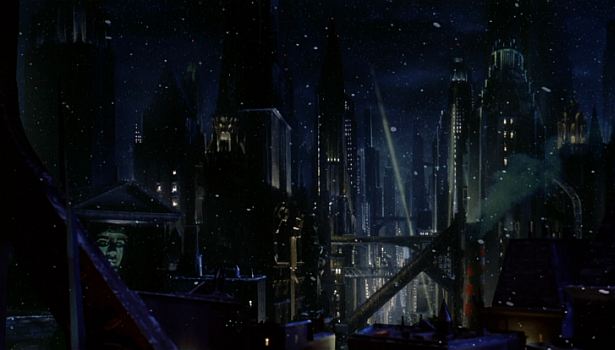
DARK DECO 
On the audio commentary for the On Leather Wings episode, Bruce Timm and Eric Radomski said that they designed the series by closely emulating the Tim Burton films' "otherworldly timelessness,". They followed the same design of the city presented in Batman Returns, Art Deco, or as they renamed it, Dark Deco and expressionistic shadowing (often painting backgrounds on black cels in order to give the feeling of omnipresent night). As in Burton's movies, there's a feel of the 1930's Industrial America with people wearing hats and driving old cars, mixed with modern and futuristic technology like computers

Alan Burnett (producer) : We called it Dark Deco. Dark Deco world with some computer technology going for it. It's just other dimension of the contemporary world (Batman Legacy Continues 2004)

Paul Dini: In my mind it was sort of like what if the 1939 world's fair had gone on another 60 years or so, and the cool sense of design  and stylishness from the Art Deco years was in operation well until the 90's. That way you could have kind of a rounded look to the cars and a stylish look to the buildings, you could have television and computers but everything would have a black and white screen (Batman Legacy Continues 2004)


 BATMOBILE
The art deco design of the Batmobile mirrored the movie Batmobile's look with the shields up

It also has the same functions and gadgets


BATCAVE
The look of the Batcave is very similar - it's basically a console and sporadic equipment scattered throughout a gigantic cave


BATWING
The Batwing, as in the movie, is of a shape of the stylized bat, with a small cabin located on top. It was also the movie which originated the term Batwing


GRAPPLING GUN
The Grappling Gun originated in Tim Burton's movies, and was since adopted into comic books and subsequent Batman movies, however the first one to adopt it was The Animated Series

Paul Dini: When we did the animated series, we were inspired in part by the tech employed in the movie (Newsrama.com 2010)

Jerry Ordway:  It was from the movie. When I did the movie comic, I was amazed at the various gadgets the prop department created for the film (...) At that time, I also understood that DC was not allowed to use any elements of that specific costume design in the comics, as it was property of the film company. I know they relaxed that rule over the last twenty years, though. (Newsrama.com 2010)

Scott Beatty (The DC Comics Encyclopedia, The Batman Handbook: The Ultimate Training Manual): The Grapnel Gun debuted in the 1989 film, but it didn't really catch on in the comics and become a regular feature in the Bat-Arsenal until it was popularized and used to great effect in Batman: The Animated Series, which debuted just a few years later (Newsrama.com 2010)


JOKER
Throughout his entire history, his outfit consisted of green shirt and orange vest. 

The 1989 movie was the first instance where the colors were reversed

The Animated Series followed. It also seems like the frozen laugh lines are present in the early episodes

Also, the 1989 movie originated the idea of Joker's pre-Joker persona being a mobster.

The 1989 movie was also the first one to introduce Joker's real name, Jack Napier, which appeared in two episodes, "Dreams In Darkness" and “Joker’s Wild”
Same sunglasses


PENGUIN
The Penguin is a mirror image of Danny DeVito's version of the character. Also, Batman Returns successfully influenced and changed the color of Penguin's outfit from blue to black in all mediums.


The depiction of Penguin (and Catwoman) however, was studio's decision


CATWOMAN
Just like in Batman Returns, Selina Kyle is blonde. However, it's worth noting that she occasional;y did appear as blonde in the Golden Age


TWO FACE
Just like in the 1989 movie, Harvey Dent/Two Face doesn't appear to be a white Caucasian, but also isn't an African American either. He seems to be of a mixed race, although this is purely a speculation as one must have in mind that his appearance was based on Ralph Bellamy


TIM BURTON CAMEO
In the beginning of the episode called "Off Balance", Batman meets an informant  named Twitch on the tower of the statue of Liberty. The informant has black hair, a long face, and has been confirmed by the producers to be "Tim Burton"


MISCELLANEOUS

The punch

The sky

The Cathedral Gargoyles

Gotham Globe

"Souvenir" from Catwoman stuck in the costume
If you noticed any other nods and references to the movies in Batman: The Animated Series, feel free to share them in the Comments